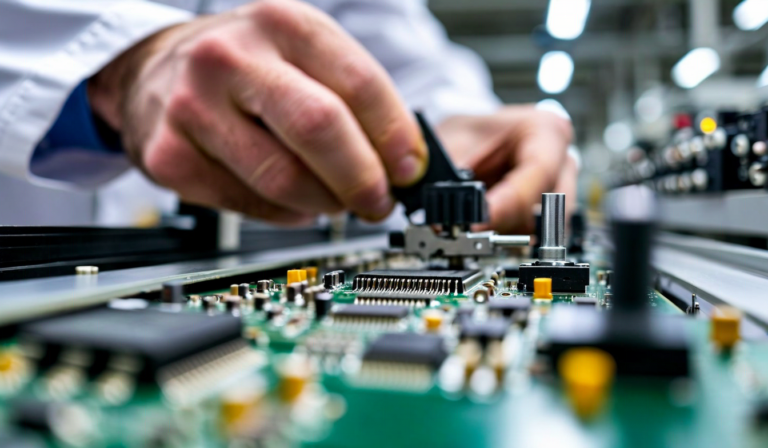
In electronics manufacturing, unplanned downtime isn't just expensive — it's cascading. When a surface mount technology line goes down, the ripple effects hit everything downstream: reflow scheduling, test station queues, and shipment windows that were already tight. The industry has long accepted a certain level of unpredictability as the cost of running high-speed, high-precision production. AI is changing that assumption.
Over the past 18 months, a growing number of electronics contract manufacturers and OEMs have deployed AI-based predictive models that can reliably flag equipment failures 48 to 72 hours before they happen. The precision isn't perfect — no prediction model is — but it's good enough to fundamentally change how maintenance is planned and how production schedules are protected.
Why Electronics Lines Are Especially Vulnerable
SMT production lines are complex systems with dozens of interdependent subsystems: pick-and-place machines running at thousands of components per hour, solder paste printers with tight tolerance windows, reflow ovens maintaining precise thermal profiles, and automated optical inspection systems that need to keep pace with the entire line.
A failure in any one of these systems doesn't just stop that station — it creates a bottleneck that backs up the entire line. And because electronics manufacturing typically runs on thin margins with contractual delivery penalties, every hour of downtime carries a disproportionately high cost. Industry estimates put the average cost of unplanned downtime for a mid-volume SMT line at $15,000 to $45,000 per hour, depending on the product and customer.
The traditional approach to managing this risk is preventive maintenance: replace components on a fixed schedule, regardless of actual condition. It works, but it's wasteful. You're replacing nozzles, feeders, and belts that may have weeks of remaining life, and you're still getting surprised by failures that don't follow the schedule.
What the AI Is Actually Watching
The predictive models deployed in electronics manufacturing environments aren't watching a single variable. They're correlating hundreds of data streams simultaneously, looking for patterns that precede failure events. For a typical SMT line, the data inputs include:
Pick-and-place machine telemetry: nozzle vacuum levels, placement accuracy deviation trends, feeder error rates, head movement acceleration profiles, and component rejection rates by feeder slot. A gradual increase in placement deviation on a specific head, even within spec, can indicate bearing wear that will cause a stoppage within days.
Solder paste printer metrics: squeegee pressure consistency, paste volume deposition variance, stencil alignment drift, and cleaning cycle frequency. When the printer starts requiring more frequent cleaning cycles to maintain consistent deposition, the model flags it as a leading indicator of stencil wear or paste degradation.
Reflow oven profiles: zone temperature stability, conveyor speed consistency, nitrogen flow rates, and thermal profile deviation from the established recipe. A 0.3-degree drift in a specific zone that trends consistently in one direction is invisible to a human reviewing hourly logs but immediately apparent to a model watching every reading.
AOI system performance: false positive rates, inspection cycle times, and lighting system intensity measurements. An increase in false positives on specific defect types often indicates camera or lighting degradation before it causes actual missed defects.
The 72-Hour Window: How It Works in Practice
The 72-hour prediction window isn't arbitrary — it's calibrated to the maintenance planning cycle of most electronics manufacturing operations. Three days is enough lead time to order parts, schedule maintenance during a planned changeover or weekend window, and adjust production scheduling to minimize impact.
When a predictive alert fires, it doesn't just say "machine X will fail." It provides context: the specific subsystem showing degradation, the pattern of data that triggered the alert, the confidence level of the prediction, and recommended maintenance actions. This context is critical because it lets maintenance teams make informed decisions about urgency and approach rather than treating every alert as an emergency.
In practice, the models achieve roughly 85% accuracy on 72-hour predictions for the most common failure modes: pick-and-place nozzle degradation, feeder mechanical failures, solder paste system issues, and reflow zone heating element degradation. The false positive rate has been a key focus area — too many false alarms and teams stop trusting the system. Current false positive rates across deployments are running between 8% and 12%, which is low enough that maintenance teams take alerts seriously without feeling overwhelmed.
Real Results from Contract Manufacturers
The data from early deployments tells a consistent story. Three contract manufacturers in the Chicago area running Intuigence AI's PredictEngine on their SMT lines reported the following results after six months of deployment:
Unplanned downtime was reduced by between 58% and 67% across the three facilities. The variation reflects differences in equipment age and baseline maintenance practices — the plant with the oldest equipment and most reactive maintenance program saw the largest improvement.
Maintenance labor costs dropped by approximately 22% on average, primarily because scheduled maintenance was replacing emergency repair work. Emergency repairs typically require premium labor rates, expedited parts shipping, and overtime — all of which go away when the work is planned in advance.
Overall equipment effectiveness improved by 9 to 14 percentage points. This was partly from reduced downtime but also from better performance and quality metrics, because machines running closer to their optimal parameters produce fewer defects and run at more consistent throughput.
What's Next: Moving Beyond Prediction to Prescription
The current generation of predictive models tells maintenance teams what's likely to fail and when. The next evolution — which we're actively developing — is prescriptive maintenance: not just predicting what will happen, but recommending the optimal response.
This means factoring in production schedules, parts inventory, labor availability, and customer delivery commitments to generate a recommended maintenance action that minimizes total cost. Should you replace the nozzle set now during the current changeover, or can it safely run through the next production batch? The model should be able to answer that question with quantified risk and cost trade-offs.
For electronics manufacturers operating in competitive markets with thin margins, this kind of intelligence isn't a luxury — it's becoming a requirement to stay competitive. The manufacturers who have adopted predictive maintenance are already operating with structurally lower costs and higher reliability. The gap will only widen.