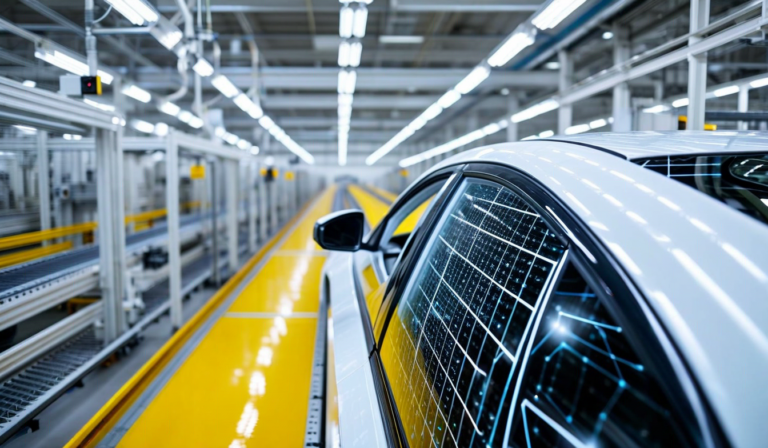
Automotive quality control is one of the highest-stakes applications in manufacturing AI. The tolerance windows are tight. The downstream consequences of a defect escape — warranty claims, recalls, customer safety, OEM scorecard penalties — are severe. And the volume is relentless: a modern assembly plant may produce thousands of vehicles per day, each one comprising hundreds of components that need to be right. We've spent the last 18 months deploying AI quality inspection at automotive manufacturers. Here's what we've learned.
The Problem AI Is Actually Solving
Before discussing results, it's worth being precise about what problem AI quality inspection addresses — because the marketing narrative around "computer vision" often implies something more general than what's actually happening in practice.
Traditional quality inspection in automotive manufacturing is a combination of three things: automated in-process gauging (coordinate measuring machines, laser scanners, vision systems at fixed inspection stations), end-of-line inspection (typically manual or semi-manual visual checks), and statistical sampling (taking a percentage of output for detailed measurement).
The problem with this approach isn't that the tools are bad. It's that they're not integrated, and they operate on different timescales. In-process gauging catches dimensional problems at the moment of production, but those systems only check what they were programmed to check and don't generalize. End-of-line inspection catches final assembly defects but often can't trace them back to root cause. Statistical sampling provides process data, but by definition it only looks at a subset of output — and defects cluster: a drifting process parameter often affects hundreds of consecutive parts before it's caught by a sampling program.
AI quality inspection doesn't replace these systems. It bridges the gaps between them by providing continuous, context-aware inspection that correlates what's being seen visually with what the process data is showing.
Paint Shop: The Hardest Environment
Of all the environments in an automotive plant, the paint shop is the most demanding for vision-based inspection. The surface you're inspecting is specular — it reflects light differently depending on viewing angle, ambient lighting conditions, and the panel geometry being inspected. A dust inclusion that's plainly visible under one lighting condition is nearly invisible under another. Human inspectors adapt to this instinctively; they move, change their viewing angle, use raking light. Teaching a machine to do the same has historically required expensive, specialized equipment.
We deployed QualityLens on a body-in-white paint inspection line at a Tier 1 supplier running production for a North American OEM. The facility was running a combination of manual final inspection and a legacy automated inspection system that had been in service for nine years. The legacy system's defect detection rate on subtle surface defects (inclusions, pinholes, and orange peel) was approximately 62% — meaning roughly 4 in 10 defects were escaping to manual inspection or, in some cases, to the customer.
After a six-week training period — during which the AI model ingested historical inspection data, paint shop process parameters, and labeled defect samples — we put QualityLens into parallel operation alongside the existing system. The results over the following 90 days:
Overall defect detection rate: 99.1% (versus 62% for the legacy system on the same defect classes)
False positive rate: 0.4% (comparable to manual inspection, and within acceptable bounds for the QA team)
Detection latency: <800ms per panel at line speed
Defect classification accuracy: 94.7% (the system correctly identifies not just the presence of a defect but the type, which enables faster root cause response)
The quality director at this facility noted something we've heard consistently across deployments: the value wasn't just in catching more defects — it was in catching them with enough context to trace them back to source. When the system flagged a cluster of pinholes over a 20-minute production window, it simultaneously surfaced a correlation with a change in spray booth humidity that had occurred 8 minutes prior. The root cause was identified and corrected within 45 minutes of the first detection. Under the prior system, that same root cause typically took 2 to 4 hours to diagnose through manual investigation.
Assembly Line: Weld Quality and Fastener Checks
Structural welds and fastener torque are two of the most consequential quality parameters in automotive assembly. A missed weld or an undertorqued fastener doesn't produce a visible defect — it produces a latent failure that may not manifest until the vehicle is in service. These are the kinds of defects that drive recalls.
Our work in weld quality inspection has focused on resistance spot welds, which are used extensively in body structure assembly. Each vehicle body contains several thousand spot welds. Traditional inspection is either sampling-based (destructive testing of a small percentage) or relies on the weld controller's own monitoring, which can verify that the welding process occurred but can't verify that the resulting weld meets structural specifications.
We built a monitoring model that correlates weld controller data (current, voltage, force, time) with downstream non-destructive testing results to train a predictive model of weld quality. The system evaluates every weld in real time against this model. Welds that fall below the confidence threshold are flagged for verification rather than passing through unexamined.
In a six-month deployment at an assembly plant in the upper Midwest, this approach reduced the weld defect escape rate by 86% compared to the prior sampling-based inspection program. Zero recall events attributable to weld quality were recorded in the deployment period, compared to two the previous year from the same facility.
What's Surprised Us in the Field
After 18 months of automotive quality AI deployments, a few things have stood out as genuinely surprising — in the sense that we expected them to be challenges and they weren't, or vice versa.
Operator adoption has been faster than expected. The conventional wisdom in manufacturing AI is that shop floor adoption is the hardest part — that experienced operators will resist or distrust AI-generated findings. We've found the opposite. Operators adopt AI inspection quickly when two conditions are met: the system doesn't generate excessive false positives (which creates noise and erodes trust), and the system's findings come with enough context to be actionable rather than cryptic. When an operator gets an alert that says "surface defect detected, panel 847, consistent with dust inclusion pattern, location mapped to quadrant B3" rather than just "defect detected," adoption is rapid.
The quality data itself has unexpected value beyond inspection. When every part is being inspected and every inspection result is being logged, you accumulate a production quality record of a richness that was previously impossible. That data, fed back into the process monitoring system, enables a quality feedback loop that starts to shift quality management from reactive to proactive. One customer used their first 90 days of AI inspection data to renegotiate supplier quality agreements on an incoming component that was consistently associated with their most common defect type — something they'd suspected but hadn't been able to prove with statistical significance until the AI logging made the correlation irrefutable.
The integration with legacy quality systems is smoother than expected. We anticipated significant friction integrating with older quality management systems and manufacturing execution systems. In practice, most automotive quality data is already structured in ways that are reasonably accessible via standard OPC-UA or database queries. The integration work that we expected to take weeks has typically taken days.
Where the Technology Still Has Limits
An honest field report has to acknowledge where AI quality inspection hasn't yet fully delivered. A few candid observations:
Novel defect types require retraining. AI vision models are excellent at detecting defect types they've been trained on. They are substantially less reliable at detecting defects they've never seen. When a new failure mode emerges — a new supplier's material behaves differently, a process change produces a new defect signature — the system needs to be retrained on examples of the new defect before it can reliably catch it. The retraining cycle has gotten faster as our tooling has matured, but it's still not zero. This means AI inspection works best as a complement to, rather than a replacement for, human inspection capability during periods of process change.
Complex geometry remains challenging. Planar or cylindrical surfaces are well-handled by current AI vision systems. Highly complex geometries — interior seams, deep recesses, areas with multiple surface finish transitions — remain harder. These are also often the areas where human inspectors are least reliable, so the limitation is symmetric, but it's worth noting.
Where This Goes in 2026 and Beyond
The trajectory of automotive AI quality inspection is clearly toward higher coverage, tighter integration with process control, and faster closed-loop response. The near-term frontier we're working toward at Intuigence AI is closing the loop between the inspection system and the process control system — so that when QualityLens detects an emerging defect pattern, it doesn't just alert a human to investigate. It automatically adjusts the relevant process parameter, validates the adjustment, and logs the entire closed-loop correction event for traceability.
That capability exists in prototype form. Making it reliable enough for automotive production environments — where the cost of a false automatic correction can be as high as the cost of a missed defect — is the engineering challenge we're working through in 2026.
For manufacturers who are currently running legacy inspection programs and wondering whether AI quality control is ready for deployment: it is, with the caveats above. The question is less whether the technology works and more whether the implementation is done right — with proper training data, clean integration, and the kind of operator engagement that makes the difference between a system that's trusted and one that's ignored.
We're happy to talk through what that looks like for your specific environment.