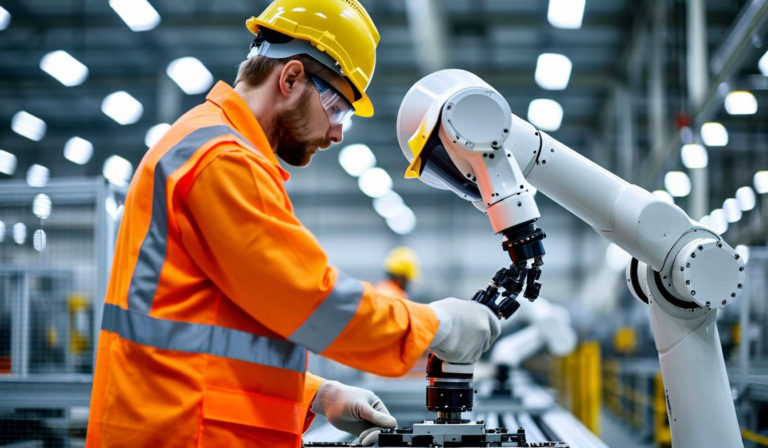
Every conversation about AI in manufacturing eventually arrives at the same question: "Are you replacing our workers?" It's the first thing plant managers ask, the first concern union representatives raise, and the undercurrent in every deployment kickoff meeting. The question deserves a direct answer — and it deserves one backed by data from real deployments, not marketing slogans.
Across every Intuigence AI deployment to date, not a single one has resulted in a net reduction of the production workforce. Zero. What has changed — significantly — is how that workforce spends its time, what information it has access to, and how effectively it can do its job.
The Rote Work Is What Gets Replaced
Manufacturing has always had a category of work that skilled people do because there's no alternative, not because it's a good use of their skill. Walking the floor to manually record gauge readings. Logging data from equipment displays into spreadsheets. Making subjective assessments about whether a sound, vibration, or reading is "normal" based on experience and intuition alone.
This is the work that AI monitoring absorbs. A synthetic AI engineer doesn't replace the operator — it replaces the clipboard, the manual log, and the 30-minute walking inspection circuit. The operator is still there. They're just doing different work now.
In a typical deployment, the shift in time allocation looks like this: operators who previously spent 40% to 50% of their shift on monitoring and data collection tasks now spend less than 10% on those activities. The freed-up time goes primarily into three areas: proactive maintenance preparation, process improvement work, and training on the AI system itself.
What Operators Actually Do With AI Insights
The most common misconception about AI in manufacturing is that it operates autonomously — that it detects a problem and fixes it without human involvement. In practice, the workflow is far more collaborative than that.
When the Intuigence AI platform detects an anomaly, it generates an alert with full context: the specific data pattern that triggered it, the affected equipment and subsystem, a confidence score, and one or more recommended actions. That alert goes to the relevant operator or maintenance technician. What happens next is entirely human.
The operator evaluates the alert against their own knowledge of the machine and the current production context. Is this machine running a different product today that might explain the reading? Was there a raw material change that could affect sensor data? Did a maintenance action last week change the baseline? The AI doesn't have this contextual knowledge — the operator does.
This is the collaboration model that actually works: the AI handles the comprehensive, continuous data analysis that no human can do at scale, and the human applies judgment, context, and decision-making authority that no AI can replicate reliably. Neither is sufficient alone. Together, they're dramatically more effective than either one operating independently.
The Skeptic-to-Advocate Pipeline
We've observed a remarkably consistent pattern across deployments. In the first two weeks, operators are skeptical. Some are openly resistant. They've been doing this work for 15 or 20 years, and a software system telling them about their machines feels like an insult to their expertise.
The turning point almost always comes from a single event: the AI catches something the operator didn't. Not because the operator was negligent — because the anomaly was in a data stream the operator physically couldn't monitor while doing everything else on the floor.
One example from a stamping plant outside Detroit: PredictEngine flagged a gradual change in hydraulic pressure variability on a 400-ton press. The variation was within the normal range for each individual reading, but the pattern of variance over a 36-hour window matched a historical signature for a servo valve degradation. The experienced operator responsible for that press later told us he never would have caught it from manual readings because each individual reading looked fine. The failure would have happened during a production run three days later and caused an estimated eight-hour shutdown.
After that event, that operator became the system's strongest advocate on the floor. Not because the AI replaced his expertise, but because it gave him capabilities he didn't have before. He could see things he couldn't see on his own. That's augmentation, not replacement.
The Skills That Become More Valuable
One of the underappreciated effects of AI deployment in manufacturing is that it actually increases the value of certain human skills. Problem-solving ability becomes more important because the AI surfaces more problems to solve. Mechanical intuition becomes more valuable because operators are evaluating AI recommendations against their experiential knowledge. Communication skills matter more because operators need to collaborate with maintenance teams, engineers, and management to act on AI insights.
Several of our deployment sites have restructured their training programs to reflect this shift. Instead of training operators primarily on equipment operation procedures, they're adding modules on data interpretation, anomaly evaluation, and root cause analysis. Operators are becoming more analytical in their approach to production management — and they're being compensated accordingly.
One contract manufacturer in the Chicago area implemented a tiered certification program specifically tied to AI system proficiency. Operators who complete the advanced tier and demonstrate the ability to effectively evaluate and act on AI-generated insights receive a pay premium. Turnover in that facility dropped by 30% in the first year of the program.
What About Maintenance Teams?
The impact on maintenance teams is equally significant and equally collaborative. Predictive maintenance doesn't eliminate the need for skilled maintenance technicians — it changes the nature of their work from predominantly reactive to predominantly planned.
Reactive maintenance is stressful, inefficient, and expensive. When a machine breaks down unexpectedly, the maintenance team drops everything to diagnose and repair it under pressure while production waits. Parts may not be in stock. The root cause may be unclear. Overtime is usually required.
Planned maintenance, driven by AI-based prediction, is the opposite. The team knows what's likely to fail, when, and why. They can order parts in advance, schedule the work during a planned window, and approach the job methodically. The technical skill required is the same — these are still complex industrial machines that need expert hands — but the working conditions are fundamentally better.
Maintenance managers consistently report that their teams prefer the predictive model, not because it's easier, but because it's more professional. They're doing proactive, strategic work instead of fighting fires. Several have told us that recruitment has become easier because they can offer a more structured, less chaotic work environment.
The Honest Conversation About Workforce Sizing
It would be dishonest to claim that AI will never affect workforce sizing in manufacturing. As plants become more productive with the same headcount, the math changes. A facility that would have needed to hire five additional operators to support a production expansion might only need three if AI is handling monitoring and early warning.
But this is the same dynamic that has played out with every productivity improvement technology in manufacturing history. CNC machines didn't eliminate machinists — they changed what machinists do and made each one more productive. The same is true of AI-assisted manufacturing.
The more pressing workforce reality in manufacturing today isn't surplus labor — it's shortage. The Manufacturing Institute estimates that 3.8 million manufacturing jobs will need to be filled in the US by 2033, with roughly half going unfilled due to skill gaps. AI isn't competing with an oversupply of workers. It's filling capability gaps that the labor market physically cannot fill.
For manufacturers wrestling with this question, the evidence from actual deployments is clear: AI makes your existing workforce more effective, makes their jobs more engaging, and addresses capability gaps that hiring alone cannot solve. That's not a threat to workers. It's an investment in them.