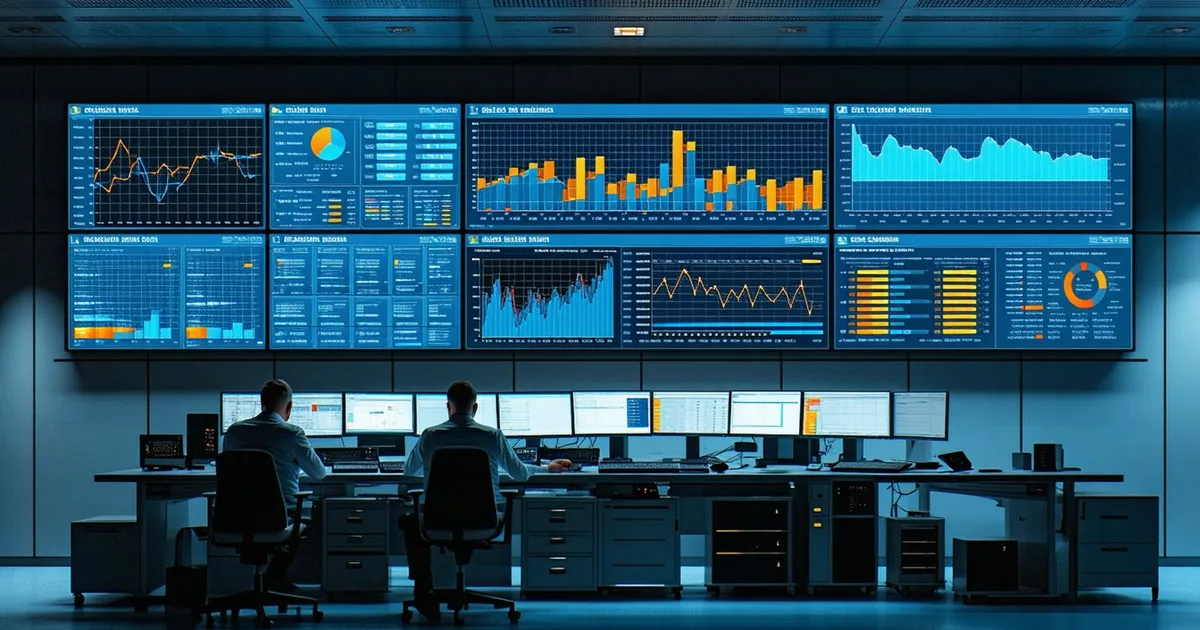
OEE Dashboards Tell You What Happened. PLC Trace Intelligence Tells You Why.
Most Tier-1 plants running discrete manufacturing have an OEE dashboard. Some have had one for 10 years. A few have had one long enough that the engineers who use it have stopped noticing what it doesn't tell them.
OEE is a measurement, not a diagnosis. The calculation — Availability × Performance × Quality Rate — is a deliberate compression of everything happening on a production line into a single percentage. That compression is valuable for exactly one purpose: understanding whether a line's output is trending in the right direction over time. It is not valuable for understanding why a specific shift ran at 67% instead of 84%, which station caused most of the loss, or what the incoming engineer should do differently in the next eight hours.
The gap between those two uses — measurement and diagnosis — is the information architecture problem that trace intelligence is designed to close.
What an OEE Dashboard Is Actually Measuring
Take the availability component. Availability = (Planned Production Time − Unplanned Downtime) / Planned Production Time. A line that ran for 420 minutes of an 8-hour shift and was down for 60 minutes shows availability of 87.5%. That number is accurate. It tells you nothing about whether the 60 minutes was one continuous fault event or twelve 5-minute micro-stops. It tells you nothing about which station caused the downtime, whether the fault was recurring or new, or whether a maintenance action was performed that resolved the cause or merely reset the fault bit.
Performance efficiency compounds the problem. Performance = (Actual Output / Maximum Possible Output) × 100. A line running at 88% performance could mean the cycle time was consistently 12% slower than nameplate — suggesting a chronic constraint — or it could mean the line ran at full speed for six hours and at 50% speed for two hours while an engineer was troubleshooting a jammed actuator. The aggregate number looks the same. The diagnostic implication is completely different.
Quality rate, the third component, at least preserves station-level meaning if your MES is logging quality gate results by station. But even then, a 97% quality rate on the dashboard masks whether the 3% defect rate was clustered at one station, distributed across three stations with different failure modes, or concentrated in a specific time window that correlates with a raw material batch.
The Information Architecture Gap
The information architecture of a typical OEE system looks like this: raw data (PLC fault events, cycle time records, quality gate results) flows into a historian or MES layer, aggregation logic runs on top, and the dashboard renders the OEE numbers. The data that feeds the dashboard is the same data that could, in principle, support diagnosis — but the aggregation step removes the diagnostic structure before the engineer ever sees it.
This is not a design flaw in OEE systems. It is a design choice. OEE was formulated by Seiichi Nakamura at Nippondenso in the 1960s as a production management metric, not a fault diagnosis tool. It was designed to be summarized, reported to plant management, and used to benchmark lines against each other and against historical performance. It was never designed to tell an engineer which PLC tag fired first this morning.
The mistake is expecting the OEE dashboard to do work it was not designed for — and then treating the shortfall as a limitation of the software vendor rather than a structural mismatch between the tool and the task.
What Trace Intelligence Adds
PLC trace intelligence operates at a different layer of the ISA-95 functional hierarchy. Where OEE operates at Level 3 (manufacturing operations management), trace analysis operates at Level 1 and 2 — the machine control and supervisory control layers where tag-level data lives. The diagnostic question — what actually happened, in what sequence, at which station — is answerable only at Levels 1 and 2.
The operational data model that ISA-95 defines includes the signal-level detail that trace intelligence requires: equipment states, process parameter values, alarm events with timestamps, and the association between production orders and physical equipment. What most implementations leave on the floor is the temporal correlation across that data — the linkage between a deviation at Station 19 and a quality failure at Station 31 that appears in the trace 22 minutes later.
Trace intelligence is not a replacement for the OEE layer. It is the layer beneath it — the diagnostic substrate that makes the OEE number actionable. When the dashboard shows 67% availability, the trace layer answers: which station, what fault mode, when did it start, what was the signal context. That answer converts the OEE number from a scorecard into a starting point for corrective action.
A Synthetic Scenario: Packaging Line in Ohio
Consider a secondary packaging line at a Tier-1 consumer goods supplier in northeastern Ohio. The line runs 18 stations on a Rockwell ControlLogix L85 platform with Studio 5000 v33, integrating with an SAP Plant Maintenance CMMS via a REST interface for work order management. The line's target OEE is 82%; actual trailing-12-week average has been sitting at 74%.
The plant's OEE dashboard shows the 74% clearly. It also shows that the gap is almost entirely in availability — downtime is running 18% above target while performance efficiency and quality rate are within 2% of goal. But the dashboard cannot show where in the line the downtime is concentrated. The plant manager looks at 74% availability and calls the maintenance supervisor. The maintenance supervisor looks at the CMMS work order backlog and sees 23 open work orders across the line. Neither of them can determine from that information whether the downtime is driven by one chronic fault station, by a random distribution of independent faults, or by a cascading problem that keeps reappearing at different stations because the root cause was never found.
The PLC trace data tells a different story. Station 7 — a product orientation servo — has been experiencing position error accumulation over multi-hour periods three to five times per week, each event eventually triggering a fault stop and manual reset. The fault stop appears in the downtime record as a "servo fault, Station 7." The manual reset appears as "reset, maintenance cleared." The root cause — a backlash in the servo's gearbox that is accumulating over the shift and causing end-of-travel position errors — never appears in any record because no corrective action was ever taken on the gearbox itself. The resets are masking a mechanical wear pattern that the OEE system records faithfully as availability loss without identifying it as a recurring mechanical degradation event.
A trace intelligence layer that correlates the position error accumulation pattern across shifts would flag this: Station 7 servo, recurring position drift, fault-reset cycle repeating at 3–5 hour intervals, consistent with mechanical backlash accumulation. The recommendation is not a reset. It is a gearbox inspection and likely replacement. One work order closes a recurring availability drain that has been hiding in 23 separate maintenance records.
The Work Order Closure Gap
There is a specific failure mode in plant maintenance that OEE dashboards make visible but cannot address: the work order that closes without correcting the underlying fault. This is the reset masquerading as a repair — fault bit cleared, machine running, work order closed, fault reappears in 48 hours.
In plants running high work order volumes — a typical Tier-1 stamping plant might generate 40–80 work orders per week on a large line — it is operationally difficult to distinguish between work orders that corrected a root cause and work orders that cleared a symptom. The CMMS records show completion in both cases. The OEE trend shows no improvement in the second case, but the trend lag — work order quality effects show up in OEE over days, not hours — means the connection between the specific work order and the lack of improvement is not visible in real time.
Trace intelligence can close this loop. After a work order is executed, the system can compare the post-maintenance trace signature at the affected station against the pre-fault baseline. If the deviation pattern that triggered the work order is still present after the maintenance action, the work order likely addressed a symptom rather than the cause. This is a signal that the CMMS and OEE systems, operating on different timescales, cannot produce on their own.
We are not claiming that every maintenance decision should wait for post-action trace verification — in some cases, the line needs to run and the verification can follow. What we are saying is that the feedback loop between maintenance action and process outcome is structurally broken in most plants because the measurement system (OEE) and the action system (CMMS work orders) operate at different temporal resolutions and are not connected at the signal level.
Practical Integration: OEE and Trace Together
The right mental model is not OEE versus trace intelligence. It is OEE as the monitoring layer and trace intelligence as the diagnostic layer, operating in parallel and connected at the work order layer. When the OEE dashboard shows an availability event, the trace layer provides the diagnostic context. The work order the trace layer generates becomes the CMMS record. When the work order closes, the trace layer verifies the outcome.
Intuigence is designed to sit in this diagnostic layer — reading PLC telemetry via OPC-UA in real-time, correlating fault signatures across stations, and generating work orders that carry the trace evidence as context. The OEE dashboard your plant already runs remains the production management view. The trace layer is the diagnostic view that makes the OEE number actionable rather than merely visible.
Plants that have tried to solve the diagnostic gap by adding more OEE features — downtime categorization trees, manual fault coding, loss categorization dropdowns — know the result: engineers spend time coding downtime events instead of diagnosing them, and the coded data is only as accurate as the engineer's real-time recall of what happened. The data structure for answering "what went wrong and why" already exists in the PLC historian. The work is connecting it to an analysis layer that can answer the question before the shift ends.